What Is WCM’s Research Partnership with Dartmouth’s Power Management Integration Center (PMIC)?
Published by West Coast Magnetics, July 2026, based on our 2026 company newsletter; content reviewed and confirmed current as of publication.
West Coast Magnetics is an industry sponsor of the Power Management Integration Center (PMIC), an NSF-backed research consortium of Dartmouth and UC San Diego directed by Professor Charlie Sullivan, one of the leading authorities on high-frequency magnetics. WCM has collaborated with Professor Sullivan for years on high-frequency magnetic design, including the shaped-foil winding it manufactures. The partnership keeps WCM connected to the research frontier while it solves the buildability problems that decide whether those advances survive production.
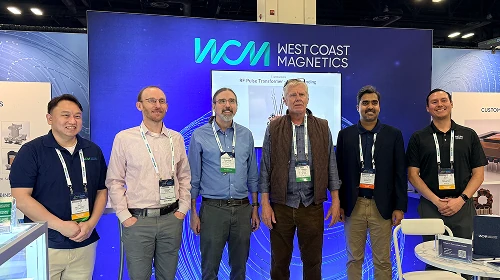
The Power Management Integration Center (PMIC) is an industry-academic research consortium of Dartmouth and UC San Diego, part of the U.S. National Science Foundation’s Industry-University Cooperative Research Centers (IUCRC) program. It brings corporate partners into the research process so that work on next-generation power electronics is guided by real-world application needs. An industry sponsor is a corporate member that helps steer and fund that research.
What PMIC Is
PMIC connects academic research with industry needs in power electronics. As part of the NSF’s IUCRC program, it brings corporate partners into the research process to focus on what matters in practice: higher efficiency, smaller form factors, and lower cost, without giving up performance and reliability in real-world systems. It is directed by Professor Charlie Sullivan, with Professor Jason Stauth also affiliated at Dartmouth’s Thayer School of Engineering.
The consortium’s research spans the areas its corporate members flag as industry-relevant:
- New circuit topologies, power-management ICs, and discrete converters for high power density and efficiency
- Next-generation passive components, inductors, transformers, and resonant structures, that operate efficiently at high frequency while reducing size and material cost
- Integrated passive components for high-density power management, leveraging semiconductor foundry processes and next-generation magnetic materials
- System design, optimization, and control for converters that use small passives at high frequency or in resonant modes
- Reliability and robustness in power electronics, including high-temperature and harsh environments and electromagnetic interference
WCM’s Collaboration with Professor Sullivan
WCM’s connection to this research is not new. The company has collaborated with Professor Sullivan for many years on high-frequency magnetic design. Sullivan is widely regarded as one of the leading experts in high-frequency magnetics and power electronics; his work centers on how magnetic components behave as systems move to higher frequencies, where efficiency, size, and material limits become tightly coupled.
That collaboration is not just academic for WCM. The shaped (cutout) foil winding that WCM manufactures was developed in collaboration with Dartmouth’s Thayer School of Engineering (Professor Charles Sullivan and Dr. Jennifer Pollock). It is the winding behind WCM’s low-AC-resistance inductors: see reducing winding losses in high-frequency inductors, the low AC resistance foil-cut inductor, and, for choosing between winding types, foil vs litz vs wire. Joining PMIC as an industry sponsor formalizes and extends a relationship that has already produced shipping technology.
Connecting Research to Buildability
PMIC is advancing what is possible in power electronics. WCM’s role is to focus on what it takes to actually build it.
As designs move toward higher frequencies, tighter tolerances, and smaller form factors, performance depends on more than the electrical design. Materials, spacing, thermal behavior, and assembly all begin to affect how the product performs. WCM stays close to ongoing research in magnetics and power electronics because those challenges show up early and fast: the same issues explored in PMIC research are the ones that have to be resolved on the production floor.
That is why WCM’s manufacturing discipline matters as much as the physics. A design has to survive sourcing, assembly, and production, which is the job of WCM’s pre-production design review and its in-house development process. The research partnership and the manufacturing rigor are two ends of the same commitment: designs that work not just in theory, but in the field. For the full design, build, and test capability set, see the WCM capabilities overview.
When standard components don’t fit your needs, our teams will engineer a solution.
FAQ
PMIC is an industry-academic research consortium of Dartmouth and UC San Diego, part of the U.S. National Science Foundation’s Industry-University Cooperative Research Centers (IUCRC) program. It connects academic research with industry needs in power electronics, bringing corporate partners into the research process to target higher efficiency, smaller form factors, and lower cost while maintaining performance and reliability. It is directed by Professor Charlie Sullivan at Dartmouth’s Thayer School of Engineering.
West Coast Magnetics is an industry sponsor of PMIC. As a corporate member, WCM helps steer research toward practical, buildable outcomes and stays connected to advances in high-frequency magnetics and power electronics. The membership formalizes a collaboration with Professor Charlie Sullivan that WCM has maintained for many years on high-frequency magnetic design.
Professor Charlie Sullivan directs the Power Management Integration Center at Dartmouth’s Thayer School of Engineering and is widely regarded as one of the leading experts in high-frequency magnetics and power electronics. His work focuses on how magnetic components behave as systems move to higher frequencies, where efficiency, size, and material limits become tightly coupled. WCM’s shaped/cutout foil winding was developed in collaboration with Dartmouth (Professor Sullivan and Dr. Pollock).
The partnership keeps WCM connected to the power-electronics research frontier while it focuses on buildability, making sure advances hold up through sourcing, assembly, and production. As designs move to higher frequencies, tighter tolerances, and smaller form factors, performance depends on materials, spacing, thermal behavior, and assembly, not the electrical design alone. WCM resolves those issues on the production floor, so a design works in the field and not only in theory.
PMIC research spans new circuit topologies and power-management ICs for high power density and efficiency; next-generation passive components (inductors, transformers, and resonant structures) that operate efficiently at high frequency while reducing size and material cost; integrated passive components using semiconductor foundry processes and next-generation magnetic materials; system design, optimization, and control for high-frequency and resonant converters; and reliability and robustness, including high-temperature, harsh-environment, and EMI considerations.
 Contact Us