How Does West Coast Magnetics Develop a Custom Magnetic Design?
Published by West Coast Magnetics, July 2026, based on our 2024 company newsletter; content reviewed and confirmed current as of publication.
West Coast Magnetics develops a custom transformer or inductor through an iterative, in-house process. Design engineers meet weekly to review each new requirement, explore multiple hypotheses, and build two to three distinct design approaches to test against the specification. The approach that performs best becomes the design, and every result is logged to inform future work. Design, 3D modeling, prototyping, and test all happen under one roof, backed by more than 1000 completed custom designs.
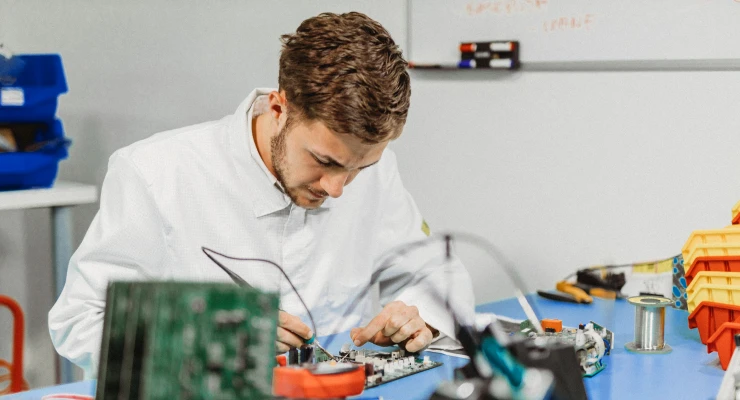
A custom magnetic design is a transformer or inductor engineered to a specific application’s electrical, thermal, and dimensional requirements rather than selected from a catalog. The development process is how WCM turns a set of requirements into a validated, manufacturable part: define the target, generate competing design approaches, prototype, and test each against the specification.
Start With the Requirement
Every custom design begins with a requirement: the electrical, thermal, and dimensional targets the part has to meet. WCM’s design engineers review each new request together in a weekly design meeting, bringing cross-team experience to bear before any single approach is chosen. That review is where the real constraints get identified early, which application the part serves, what has to be held tightly, and where there is room to trade one parameter for another.
Explore Multiple Approaches, Not One
WCM does not settle on a single approach and hope it works. For each new request, the engineering team develops two to three distinct design plans and builds them to test against the specification. Competing approaches are measured against the same targets, and the one that performs best becomes the design.
This is the core of the method. Magnetics design involves real tradeoffs between winding loss, core loss, size, cost, and thermal behavior, and the approach that looks best on paper is not always the one that measures best on the bench. Testing competing designs against the specification, rather than committing to the first idea, is what produces a part that meets the requirement rather than one that merely should.
Prototype and Test In-House
Because WCM designs and manufactures its own inductive components in-house, a design can move from 3D model to prototype to measured result without waiting on outside vendors. Prototypes are built and then verified on NIST-calibrated equipment against the target specification. The full test set, DCR to 0.5 microohms, hipot, inductance, and impedance across frequency, is described in the WCM capabilities overview. Prototyping and mid-scale build run in Stockton, California, with high-volume production in Tecate, Mexico, so a validated prototype has a direct path to production.
A Pre-Production Review Before the Floor
A design that tests well still has to be manufacturable at volume. Before a custom part reaches the production floor, it goes through a pre-production design review that checks tolerance stack-up, material compliance, and mechanical fit. The development process proves the design meets the electrical and thermal targets; the pre-production review confirms it can be built reliably and repeatably. Both gates are cleared before materials are ordered and tooling is committed.
A Knowledge Base That Compounds
Every design approach WCM builds and tests, including the ones that do not win, is logged. Those results become reference points for future designs: a tradeoff measured on one project informs the starting point on the next, so the team is rarely solving a problem from zero. More than 1000 completed custom designs sit behind each new one, which is what lets WCM commit to meeting a specification and hold a fast turnaround at the same time.
When standard components don’t fit your needs, our teams will engineer a solution.
FAQ
WCM develops a custom transformer or inductor through an iterative in-house process. Design engineers review each new requirement in a weekly design meeting, then develop two to three distinct design approaches and build them to test against the specification. The best-performing approach becomes the design. Prototyping and test happen in-house on NIST-calibrated equipment, and every result is logged to inform future designs.
Magnetics design involves real tradeoffs between winding loss, core loss, size, cost, and thermal behavior, and the approach that looks best on paper is not always the one that measures best on the bench. By building and testing two to three competing approaches against the same specification, WCM selects the design that actually meets the requirement rather than committing to the first idea. It also produces reference data that informs future projects.
The development process proves that a design meets the application’s electrical and thermal targets, through competing approaches, prototyping, and measurement. The pre-production design review is a separate, later gate that confirms the chosen design can be manufactured reliably and repeatably, checking tolerance stack-up, material compliance, and mechanical fit before materials are ordered and tooling is committed.
Yes. WCM designs and manufactures its own inductive components in-house, so a design moves from 3D model to prototype to measured result without waiting on outside vendors. Prototypes are verified on NIST-calibrated test equipment against the target specification. Prototyping and mid-scale build run in Stockton, California, with high-volume production in Tecate, Mexico.
WCM holds a fast turnaround by designing and building in-house and by drawing on more than 1000 completed custom designs. Prior results, logged from every approach the team has built and tested, give each new project a validated starting point instead of a blank sheet, which shortens the path from requirement to a design that meets the specification.
 Contact Us