What Are WCM’s SMPS Transformer Design Kits (WCM410 and WCM420)?
Published by West Coast Magnetics, July 2026, based on our design-kit product line and 2021 product announcement; content reviewed and confirmed current as of publication.
WCM’s design kits are matched sets of ferrite E-cores and bobbins from its WCM410 and WCM420 SMPS transformer series, sold so an engineer can wind and assemble their own transformers or inductors instead of ordering a finished custom part. The kits use low-loss Mn-Zn ferrite intended for 50 kHz to 700 kHz, ship with full specifications, span roughly 125 W to 5 kW across six configurations, and can reach isolation up to 5000 Vac. When the design is done, you send it to WCM for a quick-turn prototype.
Some power-electronics engineers are perfectly capable of designing and winding their own magnetics and would rather prototype in-house than hand off a spec and wait. WCM’s design kits, an industry first, exist for exactly that workflow: they put WCM’s own high-power-density, low-loss cores and matching bobbins in the engineer’s hands, with the specifications needed to design around them. This article covers what’s in the kits and how to choose one. The full ordering page is WCM design kits.
Why a Design Kit Instead of a Finished Custom Transformer?
WCM’s usual model is to design and build a custom magnetic to your specification. The design kits invert that for engineers who want to keep the winding and prototyping in-house: rather than order a finished part, you buy the same cores and bobbins WCM uses in its WCM410 and WCM420 transformer series, wind your own design, and validate it on the bench. You get components you can trust (the ones WCM ships in production) plus the full specifications to design with, and you keep full control of the winding and iteration. When you’re ready to scale, WCM turns your design into quick-turn prototypes and production parts. The underlying design decisions (core geometry, isolation, thermal) are covered in the SMPS transformer design guide and the winding-conductor selection guide.
The Six Kit Configurations
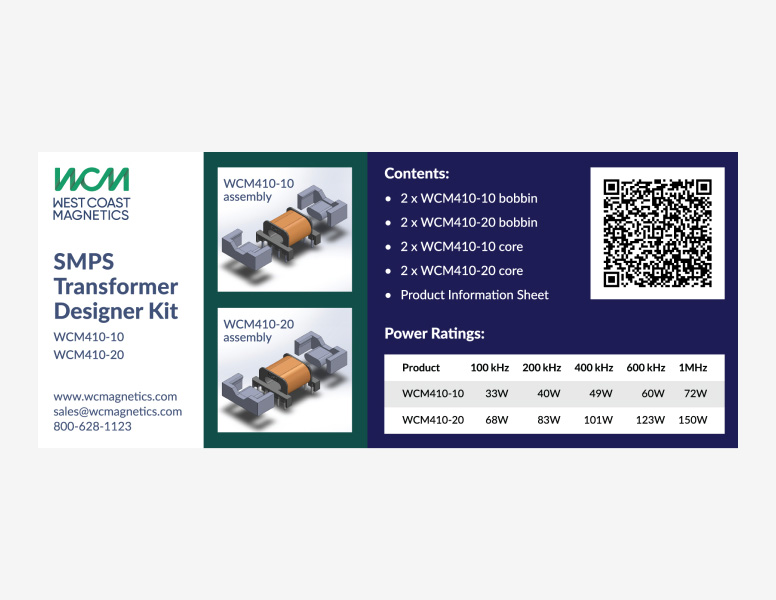
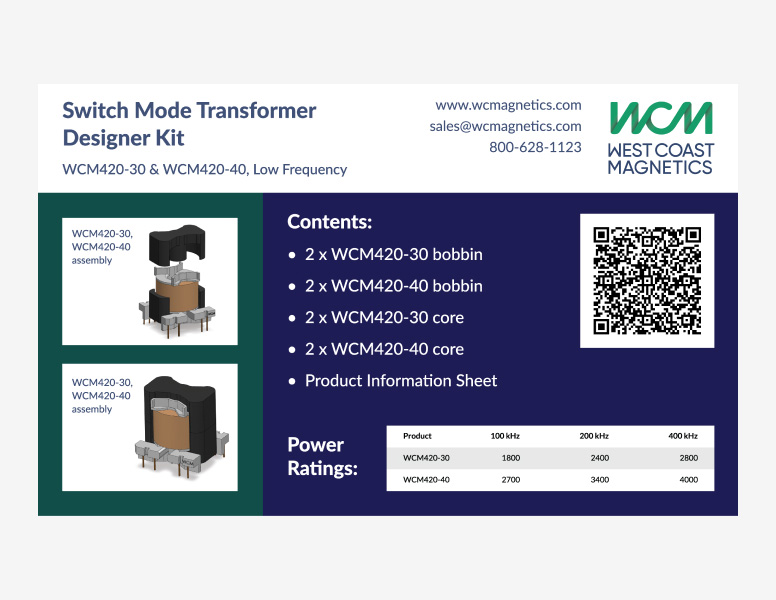
Each kit contains two each of the two cores and two matching bobbins in its range. The six kits ladder from low power to 5 kW:
| Kit | Series | Power (up to) | Contents |
|---|---|---|---|
| WCM410-10 / WCM410-20 | WCM410 | 125 W | 2× each core + bobbin |
| WCM410-30 / WCM410-40 | WCM410 | 450 W | 2× each core + bobbin |
| WCM410-50 / WCM410-60 | WCM410 | 1.5 kW | 2× each core + bobbin |
| WCM410-70 / WCM410-88 | WCM410 | 4 kW | 2× each core + bobbin |
| WCM420-10 / WCM420-20 | WCM420 | 2.5 kW | 2× each core + bobbin |
| WCM420-30 / WCM420-40 | WCM420 | 5 kW | 2× each core + bobbin |
All kits are stocked for immediate order. Each comes with a product information sheet carrying the core and bobbin specifications you design against.
WCM410 vs WCM420: Which Series?
The two series suit different designs:
- WCM410 is WCM’s PC-mount E-core family, designed to deliver about 50% more power density than comparable geometries without giving up isolation, and usable up to 2 MHz. Its cores use WCM’s low-loss WCM-F300 ferrite (with the higher-power -70 and -88 kits using the higher-permeability WCM-F100). It covers the low-to-high-power range in a board-mountable form.
- WCM420 is a PQ-style family with a finite-element-optimized core geometry that equalizes flux distribution and minimizes board space, and it meets stringent medical creepage and clearance requirements. It uses WCM-F200 ferrite for switching up to 500 kHz and the low-permeability WCM-FM400 grade above 500 kHz, and carries the higher-power kits (up to 5 kW).
If board space and medical isolation dominate, WCM420 is the starting point; if you want the widest frequency range and PC-mount convenience, WCM410 is. Both can achieve isolation up to 5000 Vac in a wound design.
The Core Material
The kit cores are low-loss Mn-Zn ferrite chosen for the 50 kHz to 700 kHz band that most SMPS transformers operate in. WCM offers four grades across the two series, differing mainly in initial permeability and how they trade loss against frequency: WCM-F300 (µi ≈ 1400, high resistivity for low loss), WCM-F100 (µi ≈ 2500), WCM-F200 (µi ≈ 3000), and the low-permeability WCM-FM400 (µi ≈ 900) for the highest switching frequencies. Matching the grade to your frequency and power is the first design decision the kits let you make yourself.
From Kit to Prototype
The workflow is simple: request the kit that spans your power level, wind your design against the supplied specifications, and validate it. When the design is proven, send it to WCM for a quick-turn prototype and, eventually, production. That path keeps the early iteration fast and in your hands while still landing on a manufacturable part built by WCM. For the full scope of WCM’s design, build, and test capability, see the capabilities overview.
When standard components don’t fit your needs, our teams will engineer a solution.
FAQ
A transformer design kit is a set of matched ferrite E-cores and bobbins that lets an engineer wind and assemble their own transformer or inductor rather than ordering a finished custom part. WCM’s kits contain the same high-power-density, low-loss cores and matching bobbins it uses in its WCM410 and WCM420 series, plus the full specifications needed to design around them.
Six configurations ladder from low power to 5 kW: WCM410-10/20 up to 125 W, WCM410-30/40 up to 450 W, WCM410-50/60 up to 1.5 kW, WCM410-70/88 up to 4 kW, WCM420-10/20 up to 2.5 kW, and WCM420-30/40 up to 5 kW. Each kit contains two each of its two cores and two matching bobbins.
WCM410 is a PC-mount E-core series designed for about 50% more power density without sacrificing isolation, usable up to 2 MHz, using WCM-F300 (and WCM-F100 for the highest-power kits). WCM420 is a PQ-style series with a finite-element-optimized geometry that saves board space and meets stringent medical creepage and clearance, using WCM-F200 up to 500 kHz and the low-permeability WCM-FM400 above 500 kHz.
The cores are low-loss Mn-Zn ferrite intended for use from 50 kHz to 700 kHz (the WCM410 geometry extends to 2 MHz), and a wound design can achieve isolation up to 5000 Vac. The low-profile bobbins provide large window area and plenty of pin connections to support a range of turns counts and isolation schemes.
Yes. The kits are meant to speed your in-house design and winding; once the design is proven, you send it to WCM for a quick-turn prototype and then production. You keep control of the early iteration, and WCM manufactures the finished part to the design you validated.
 Contact Us