What Is a Pre-Production Design Review, and Why Does It Matter for Custom Magnetics?
Published by West Coast Magnetics, July 2026, based on our 2026 company newsletter; content reviewed and confirmed current as of publication.
A pre-production design review is a structured check of a component design for manufacturability and reliability before any material is ordered or tooling is cut. West Coast Magnetics reviews every custom magnetics design through this lens, identifying unrealistic tolerances, unclear specifications, mechanical conflicts, and noncompliant materials early. The result is proactive risk prevention: the customer avoids redesign loops, production delays, field failures, and costly recalls.
A pre-production design review is an engineering evaluation of a drawing and specification set for build feasibility, performed before materials are ordered and tooling is cut. It checks whether a design that is technically correct on paper can actually be built and will hold up in the field.
Design for manufacturability (DFM) is the practice of evaluating a design for how it will be built, not just whether it meets its electrical spec. Tolerance stack-up is the accumulation of individual dimensional tolerances across an assembly: each dimension can be within spec while the assembled result is impossible to build or assemble. Catching stack-up problems before build is one of the core jobs of a pre-production review.
What a Pre-Production Design Review Checks
At WCM, building to print isn’t enough. Every customer design is reviewed through a manufacturability and reliability lens before it reaches the production floor. A dimension may be technically “in spec,” yet impossible to assemble once real-world tolerance stack-up is considered.
The engineering team reviews drawings for feasibility, looking for the problems that turn into production stoppages or field failures later:
- Unrealistic tolerances that cannot be held repeatably in production, or that make assembly physically impossible once stack-up is accounted for
- Unclear specifications that leave a build decision open to interpretation on the floor
- Mechanical conflicts between parts, clearances, or the enclosure that would halt assembly
- Material compliance gaps, including flammability standards for plastics and other regulated material requirements
These issues are addressed before materials are ordered, before tooling is cut, and before operators begin building. Correcting a tolerance on a drawing costs a review comment. Correcting it after tooling is cut and the first production lot has failed costs weeks and, sometimes, a field recall.
Material Compliance: Catching Noncompliant Materials Before Build
Material compliance is a critical checkpoint in the review. WCM recently uncovered that a customer-specified plastic did not meet required flammability standards, an issue that had previously led to a failure elsewhere. Because that noncompliance was identified and corrected during pre-production review, the customer prevented a recurrence.
Material verification extends to the supply chain. WCM’s terms require suppliers to provide RoHS, REACH, and TSCA compliance certifications on request, and to certify that products are conflict-free per Section 1502 of the Dodd-Frank Act. WCM also runs a supplier qualification and supply-chain continuity program, with multiple supplier relationships cultivated over decades so that a compliant material is available from more than one source. Supplier weaknesses are identified early, before they become a single point of failure in a production run.
Designing for the Real World: RF and High-Power Reliability
In RF and high-power assemblies, small mechanical details directly affect performance. That is why WCM evaluates dimensions not just for fit, but for how they will behave under real operating conditions.
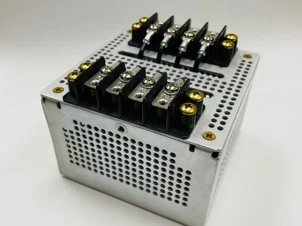
In RF systems, the enclosure becomes part of the circuit: its geometry influences signal behavior, so it has to be evaluated alongside the electrical design rather than treated as a box the parts go into. WCM’s RF filter work depends on exactly this discipline. For an example of how enclosure and component design come together in a tuned filter, see 13.56 MHz RF filters for semiconductor etch.
In high-power builds, spacing and clearances determine voltage safety and long-term reliability. A creepage or clearance dimension that looks acceptable on a drawing can become a breakdown path under real voltage and thermal stress. Reviewing those dimensions against the operating conditions, not just the nominal fit, is what keeps a high-power part reliable in the field. The value of that review shows up clearly in a real case: WCM’s EV charger transformer redesign traced a customer’s efficiency and oscillation problem to the winding construction and corrected it before it reached production.
Why Early Risk Prevention Pays Off
These interventions may happen quietly, but their impact is significant. By identifying risks early, WCM helps customers avoid redesign loops, production delays, field failures, and costly recalls. The review turns problems that would surface expensively downstream into review comments that cost nothing but engineering attention.
The result is proactive risk prevention:
- Unrealistic tolerances are corrected on the drawing
- Noncompliant materials are stopped before build
- Supplier weaknesses are identified early
- Manufacturability gaps are resolved before release
By the time a product ships, it has already been evaluated for performance and reliability. This is WCM’s safeguard philosophy in action: protecting the customer’s intent before it reaches the field.
The Quality System Behind the Review

The pre-production review is backed by a formal quality system. West Coast Magnetics is certified to ISO 9001 and ISO 13485, and holds IPC 610 and IPC 620 certifications for soldering, crimping, and connector installation. The ISO 13485 scope focuses on risk management across the entire product life cycle and supports customer traceability and documentation for FDA submissions, which matters for the medical device magnetics WCM builds.
The engineering methods behind the review are drawn from a Quality-by-Design toolkit: root cause analysis, PFMEA and DFMEA, DFMA, process validation, finite element analysis, and 2D and 3D modeling. WCM engineers bring experience from Silicon Valley technology companies, and the company has designed and manufactured magnetics in-house since it was founded in 1974, with more than 1000 successful custom designs to its credit across semiconductor, medical, military and aerospace, communications, and industrial markets.
Because WCM designs and manufactures its own inductive components in-house, the design review and the build happen under one roof. The engineers who catch a tolerance or clearance problem are the same team that will build the part, which is what makes the review a real safeguard rather than a paperwork step.
FAQ
A pre-production design review is a structured engineering check of a component’s drawing and specification set for manufacturability and reliability, performed before materials are ordered and tooling is cut. It confirms that a design which is correct on paper can actually be built and will hold up under real operating conditions. WCM reviews every custom design this way, catching unrealistic tolerances, unclear specifications, mechanical conflicts, and noncompliant materials before they reach the production floor.
WCM checks for unrealistic tolerances that cannot be held repeatably in production, unclear specifications that leave build decisions open to interpretation, mechanical conflicts between parts or the enclosure, and material compliance including flammability standards for plastics. In RF assemblies it also evaluates enclosure geometry as part of the circuit, and in high-power builds it evaluates spacing and clearances for voltage safety and long-term reliability.
Tolerance stack-up is the accumulation of individual dimensional tolerances across an assembly. Each dimension can be within its own tolerance while the assembled result is impossible to build or assemble. It matters because a design can be technically “in spec” on every individual dimension yet fail at assembly, so a review that only checks dimensions in isolation misses the problem. Catching stack-up issues before build is a core job of the pre-production review.
Material compliance is a checkpoint in the pre-production review. WCM verifies material requirements such as flammability standards for plastics, and its terms require suppliers to provide RoHS, REACH, and TSCA compliance certifications on request. WCM has caught a customer-specified plastic that did not meet required flammability standards during review, preventing a recurrence of a failure that had happened elsewhere. A supplier qualification program with multiple sources reduces the risk of a single noncompliant or unavailable material.
In RF systems, the enclosure becomes part of the circuit: its geometry influences signal behavior. That means the mechanical design of the enclosure has to be reviewed alongside the electrical design, not treated as a separate box. A dimension that looks fine mechanically can shift the RF performance, which is why WCM evaluates enclosure geometry as part of the circuit review for RF assemblies.
West Coast Magnetics is certified to ISO 9001 and ISO 13485, and holds IPC 610 and IPC 620 certifications for soldering, crimping, and connector installation. The ISO 13485 scope focuses on risk management across the product life cycle and supports customer traceability and documentation for FDA submissions. WCM’s engineering methods include root cause analysis, PFMEA, DFMEA, DFMA, process validation, and finite element analysis.
 Contact Us