What Are Nanocrystalline Common-Mode Chokes, and When Should You Use One?
Published by West Coast Magnetics, July 2026, based on our 2021 company newsletter; content reviewed and confirmed current as of publication.
A nanocrystalline common-mode choke delivers higher attenuation in a smaller footprint than a ferrite-core equivalent, making it the right choice when board space is tight and common-mode noise rejection from 10 kHz to 10 MHz must be strong across a current range from a few amps up to 52 A.
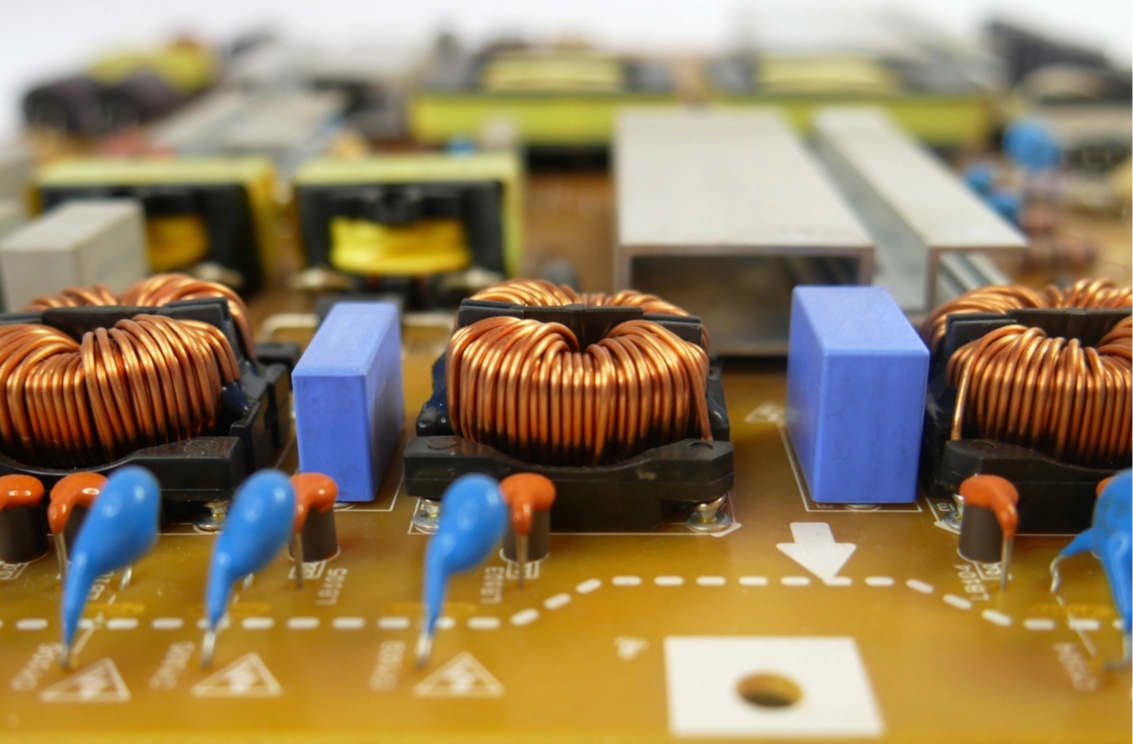
Common-mode choke: a two-winding magnetic component that passes differential-mode current while blocking common-mode noise. The windings are connected out of phase so the core impedance is seen only by common-mode noise, not by the load current flowing through the line.
Nanocrystalline core: a soft-magnetic core material made from an amorphous precursor that is partially crystallized into nanometer-scale grains. Nanocrystalline material combines high saturation flux density with very low core losses at frequencies from 10 kHz into the MHz range, which is why it can achieve more attenuation in a smaller package than conventional ferrite.
How Does a Common-Mode Choke Work?
A common-mode choke places two windings on a common core, with each winding carrying one conductor of the line. The windings are wound in opposite phase so that the magnetic flux produced by differential-mode (load) current cancels in the core, leaving the core impedance effectively invisible to differential current. Common-mode noise currents, by contrast, flow in the same direction on both conductors, so their flux adds in the core. The high core impedance then attenuates that noise.
The result is a component that does not impede normal load current but presents a high series impedance to common-mode disturbances. A well-designed common-mode choke delivers high attenuation of common-mode noise over roughly 10 kHz to 10 MHz without overheating at full RMS power. In practice, these parts suppress the common-mode EMI on power and signal lines that equipment must control to meet conducted-emissions limits.
The quality of that attenuation depends heavily on the core material. Ferrite cores are widely used and cost-effective, but nanocrystalline cores offer higher permeability and lower losses at the relevant frequencies. That means nanocrystalline cores can reach higher inductance levels in the same physical volume, or reach equivalent inductance in a smaller core.
Why Choose Nanocrystalline Over Ferrite?
Nanocrystalline cores provide more attenuation in a smaller footprint than ferrite cores. That statement covers three practical benefits:
- Higher inductance per unit volume. The higher permeability of nanocrystalline material means a given core geometry can reach inductances that would require a significantly larger ferrite core. WCM’s nanocrystalline chokes reach inductance as high as 131.3 mH measured at 10 kHz (WCM511 series).
- Lower core losses at mid-frequencies. Nanocrystalline material performs well across the 10 kHz to 10 MHz attenuation band relevant to most EMC applications, without the steep loss increase ferrite can show at higher frequencies.
- Smaller footprint at equivalent performance. For a given inductance target, a nanocrystalline choke takes less board area than its ferrite counterpart. That matters when the choke is on a dense surface-mount assembly and every square millimeter counts.
The tradeoff is cost: nanocrystalline and amorphous cores are notably more expensive than ferrite cores. For applications where space is constrained or the attenuation requirement is high, that cost is justified. For large, low-frequency applications where board space is not limiting, ferrite remains a practical choice. WCM’s broader 50x choke family covers both directions.
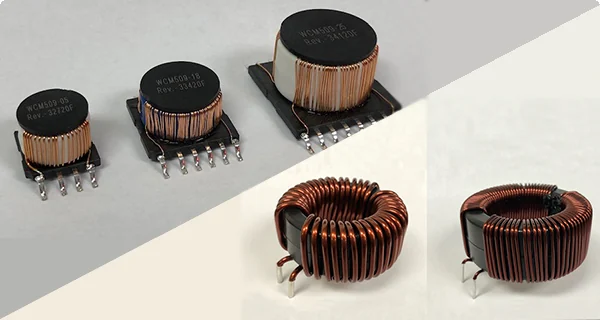
WCM509 Series: Up to 8.7 A, Up to 116 mH, Three SMD Form Factors
The WCM509 series is WCM’s standard nanocrystalline surface-mount choke for applications up to 8.7 A. Nine variants (-01 through -09) span the following ranges:
- Inductance (minimum): up to 116 mH
- Inductance at 10 kHz: 1.43–9.92 mH across the series
- Rated current (WCM509-01): 6.4 A at 40 °C rise / 7.6 A at 60 °C rise / 8.7 A at 80 °C rise
- Leakage inductance: 14–100 µH
- DCR: 16–241 mΩ
- Hipot: 1500 Vac
- Mounting: surface-mount, pick-and-place compatible
- Form factors: three, to fit the footprint your layout requires
Three form factors give you a tailored fit to your PCB geometry without compromising on electrical performance. All form factors are pick-and-place compatible, which supports high-volume production without additional handling steps.
The 1500 Vac hipot rating on the WCM509 series is an isolation voltage between windings, not an operating voltage. It is a measure of the winding-to-winding insulation strength, relevant when the choke sits in a circuit with high transient voltages or regulatory isolation requirements.
WCM510 Series: Up to 52 A, the Highest Current Nanocrystalline Choke WCM Offers
The WCM510 series is the largest nanocrystalline common-mode choke in WCM’s catalog. Six variants (-01 through -06) cover high-current applications where nanocrystalline attenuation is needed at sustained operating currents:
- Rated current (WCM510-01): 33.0 A at 40 °C rise / 42.5 A at 60 °C rise / 52.0 A at 80 °C rise
- Inductance at 10 kHz: 4.05–43.5 mH across the series
- DCR: 3–101 mΩ
- Hipot: 1500 Vac
The WCM510 provides high attenuation at operating currents up to 52 A. At this current level, ferrite cores cannot achieve the levels of attenuation that nanocrystalline technology enables in the same footprint. That makes the WCM510 the right part when the circuit carries high continuous current and the EMC requirement cannot be met by a ferrite choke of the same size.
Low DCR at high current matters thermally. At 52 A, even a small resistance causes significant self-heating. The WCM510-01’s 3 mΩ minimum DCR keeps resistive loss in check at full current.
WCM511 Series: Extended Inductance Range, Up to 26 A
The WCM511 series fills the inductance range between the WCM509 and the WCM510, with an emphasis on very high inductance and peak impedance values. Eight variants (-10 through -80) offer:
- Inductance at 10 kHz: 3.5–131.3 mH
- Peak impedance: 10–90 kΩ
- Leakage inductance: 3.5–138.7 µH
- DCR: 2.9–398.4 mΩ
- Rated current: 1.2–18.0 A at 40 °C rise, up to 26.0 A at 80 °C rise
- Hipot: 1500 Vac
- Mounting: surface-mount
The WCM511’s peak impedance specification, ranging from 10 kΩ to 90 kΩ, tells you directly how high the series impedance will be at the frequency where the choke is most effective. For applications where the noise rejection requirement is specified in impedance terms, this is a more direct design parameter than inductance alone.
Series Comparison Table
| Series | Current (max) | Inductance at 10 kHz | Hipot | Mounting | Variants |
|---|---|---|---|---|---|
| WCM509 | 8.7 A (80 °C rise) | 1.43–9.92 mH | 1500 Vac | SMD, 3 form factors | -01 to -09 |
| WCM510 | 52.0 A (80 °C rise) | 4.05–43.5 mH | 1500 Vac | See datasheet | -01 to -06 |
| WCM511 | 26.0 A (80 °C rise) | 3.5–131.3 mH | 1500 Vac | SMD | -10 to -80 |
All three series use nanocrystalline cores and 1500 Vac isolation; the WCM509 and WCM511 are surface-mount, pick-and-place-compatible parts (see the WCM510 datasheet for its mounting and form factor). The current rating drives the series selection first; inductance and peak impedance then select the variant.
How Does WCM’s Precision Test Capability Support Consistent Choke Performance?
Test consistency matters for common-mode chokes because inductance variation between parts translates directly to variation in attenuation. In a multi-year engineering effort reported in 2021, WCM developed test methods targeting single-point measurement accuracy exceeding ±0.1% for inductance, impedance, and Q from 400 kHz to 40 MHz.
That work involved the RF, electronic, and mechanical engineering teams developing fixturing, process methods, and instrumentation to achieve this accuracy. Manufacturing and quality control addressed environmental influences, operator effects, and equipment setup using Gauge R&R and Process Capability analysis to isolate non-equipment influences on test results. The aim of that measurement discipline is consistent, repeatable part-to-part performance in the chokes WCM designs and builds.
For engineers qualifying parts for a noise-sensitive application, that measurement accuracy means that a choke’s specified inductance and impedance are numbers you can rely on across a production run, not nominal values with large, unstated measurement uncertainty.
How to Choose Between the WCM509, WCM510, and WCM511
The selection path follows the circuit’s operating current first, then the inductance or impedance target:
1. Operating current up to 8.7 A: the WCM509 series covers this range in nine variants with minimum inductance up to 116 mH. If the layout footprint is a constraint, the three available form factors give you a dimensional choice without sacrificing performance.
2. Operating current from roughly 9 A to 26 A, with high inductance or impedance priority: the WCM511 series is the right starting point, with inductance up to 131.3 mH and peak impedance up to 90 kΩ in eight variants.
3. Operating current above 26 A, up to 52 A: the WCM510 series is WCM’s highest-current nanocrystalline choke, providing high attenuation at sustained currents that ferrite chokes of comparable size cannot match.
4. Current range met but inductance or attenuation target not met by a standard variant: WCM designs custom nanocrystalline common-mode chokes. Because we design without relying on off-the-shelf cores or bobbins, the inductance, form factor, and current rating can be engineered to your specification.
WCM’s common-mode choke design team is available to discuss your application. If none of the standard series meets your combination of current, inductance, and footprint constraints, our team starts from your requirements. See the full common-mode choke catalog for the complete lineup.
When standard components don’t fit your needs, contact WCM to have an engineer discuss your application.
FAQ
A nanocrystalline common-mode choke is a two-winding magnetic component that uses a nanocrystalline soft-magnetic core to block common-mode noise while passing differential-mode (load) current. The windings are wound out of phase so the core impedance is seen only by common-mode noise. Nanocrystalline material provides higher permeability and lower core losses than ferrite at frequencies from 10 kHz to 10 MHz, enabling more attenuation in a smaller footprint.
All three series use nanocrystalline cores and provide 1500 Vac isolation; the WCM509 and WCM511 are surface-mount parts, while the WCM510’s mounting is given on its datasheet. The primary difference is current rating: the WCM509 handles up to 8.7 A, the WCM511 up to 26.0 A, and the WCM510 up to 52.0 A. The WCM509 is available in three form factors for layout flexibility; the WCM511 emphasizes high inductance (up to 131.3 mH) and peak impedance (up to 90 kΩ); and the WCM510 is WCM’s largest nanocrystalline choke, rated for the highest continuous currents.
Use a nanocrystalline choke when board space is limited and you need more attenuation than a ferrite core of the same size can provide, or when the inductance target is high enough that a ferrite core would require an impractically large form factor. At very high currents, particularly above roughly 25 A in a surface-mount package, nanocrystalline technology can achieve attenuation levels that ferrite cores of comparable size cannot match. The tradeoff is higher core material cost, which is justified when the attenuation or size requirement cannot be met by ferrite.
The 1500 Vac hipot rating is the winding-to-winding isolation voltage, not an operating voltage. It specifies that the insulation between the two windings withstands a 1500 Vac test voltage. This matters when the choke is installed in a circuit that sees high transient voltages or that must meet a regulatory isolation requirement between the two conductors the choke is placed on.
Measured at 10 kHz, inductance ranges up to 43.5 mH on the WCM510 series and up to 131.3 mH on the WCM511 series. The WCM509 series is additionally specified with a minimum inductance up to 116 mH. Which figure matters depends on your operating frequency and how the noise-rejection requirement is specified: as an inductance value or, for the WCM511, as peak impedance up to 90 kΩ.
Yes. WCM designs custom common-mode chokes, including nanocrystalline designs, to customer specifications for inductance, current, form factor, and isolation. Because we design our own inductive components without relying on off-the-shelf cores or bobbins, we can engineer a nanocrystalline choke to your electrical, thermal, and dimensional requirements. Contact us or visit our custom common-mode choke design page to start the discussion.
 Contact Us