How Do You Choose a Core for a High-Power SMPS Transformer?
Published by West Coast Magnetics, July 2026, based on our technical paper on designing high-power, high-frequency magnetics (available for download below); content reviewed and confirmed current as of publication.
At high power the core problem is not a simple scale-up: required core volume rises faster than power, ferrite gives the best loss/size/cost tradeoff but is hard to source (and mechanically fragile) much above 10 kW, and the flux density a core can run at must be reduced as power increases. So choosing a core for a high-power SMPS transformer is a materials-and-size tradeoff, not just picking a bigger version of a low-power core.
Core volume does not scale linearly with power. Higher power levels require more core volume per unit of power than lower power levels, and this result is independent of switching frequency.
High-power, high-frequency magnetics are increasingly demanded by hybrid-vehicle powertrains, electric and industrial drives, large-scale solar converters, and grid-level (wind) energy conversion. Pushing SMPS transformers into the medium-to-high kilowatt range creates core-selection problems that don’t appear at low power. This article covers the three that matter most. It pairs with high-power SMPS magnetics design tips for winding and thermal decisions, and with the broader outlook for medium- and high-power magnetics.
Why Core Volume Doesn’t Scale Linearly With Power
The fundamental constraint is power density in the core. As power rises, you need disproportionately more core volume for each watt you process, regardless of frequency. There are two reasons: the core material options change at high power, and the allowable flux density falls as cores get larger. Both are covered below.
Ferrite Is the Best Tradeoff, But Hard to Get Above 10 kW
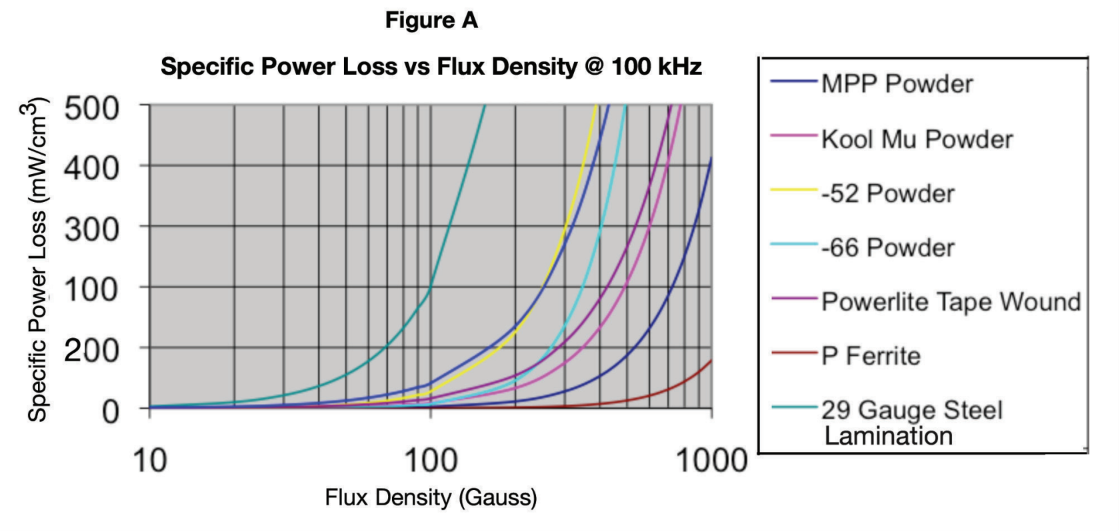
For SMPS frequencies, ferrite usually offers the best combination of cost, size, and performance because its losses are typically lower than the alternatives at those frequencies. The practical problems appear at high power:
- Availability. Ferrite is not widely available in sizes that can process 10 kW and higher.
- Mechanical fragility. Ferrite is inherently brittle and prone to fracturing, especially in larger sizes, a real concern for high-power equipment that lives in shock- and vibration-prone environments.
- The alternatives cost more and lose more. Substitute materials such as MPP powder and lamination steel are both lossier and more expensive than ferrite at SMPS frequencies.
| Core material | SMPS-frequency loss | Relative cost | High-power note |
|---|---|---|---|
| Ferrite | Lowest | Lowest | Best tradeoff; limited availability and brittle above ~10 kW |
| MPP powder | Higher than ferrite | Higher than ferrite | Distributed gap, but lossier |
| Lamination steel | Higher than ferrite | Higher than ferrite | Mechanically robust, but lossy at SMPS frequencies |
This is why high-power design demands broader comfort with core materials than low-power work: more shape and material options become viable, and the “obvious” ferrite choice may not be available or robust enough.
Flux Density Must Drop as Power Rises
The second reason core volume outpaces power is that larger cores cannot support the same flux density (gauss) as smaller cores without overheating. As a transformer’s power level increases, the allowable gauss must come down, independent of core material and operating frequency.
The paper illustrates this with three transformer designs built on the same low-loss 2000-permeability ferrite, all at 100 kHz and the same 40 °C hot-spot rise from core loss:
| Design (100 kHz, 40 °C rise) | Allowable flux density | Core-loss density |
|---|---|---|
| 1 kW, PCB-mount | ≈ 1240 gauss | ≈ 140 mW/cm³ |
| 5 kW, chassis-mount | ≈ 920 gauss | ≈ 61 mW/cm³ |
| 25 kW, chassis-mount | ≈ 612 gauss | ≈ 22 mW/cm³ |
Illustrative design-study comparison from the source paper (not product ratings): the same ferrite, frequency, and temperature rise, scaled across power levels.
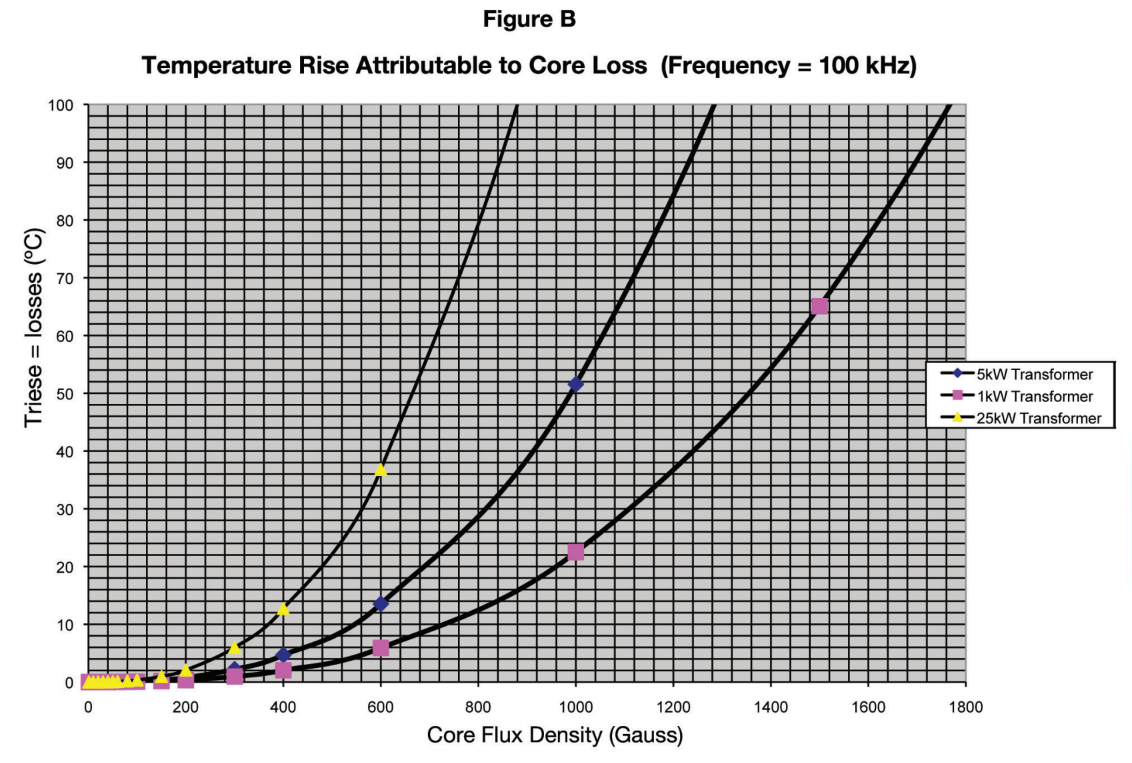
The smaller core runs at roughly twice the flux density of the large one for the same thermal budget. Because the core processes power in proportion to flux density (among other factors), halving the allowable gauss means the high-power design needs far more core cross-section per watt. The trend continues as power climbs and holds regardless of the material or frequency you pick.
What This Means for Your Design
Choosing a high-power core is a deliberate tradeoff: start from ferrite for its loss advantage, confirm it is available and mechanically adequate at your size and environment, and size the core for the reduced flux density that a large core allows rather than the gauss you would use at low power. When ferrite can’t meet the size or ruggedness requirement, the alternatives are on the table, at a loss and cost penalty you design around. WCM designs its own cores and bobbins in-house, which is what lets a high-power design use the right geometry rather than the nearest catalog part; see the WCM capabilities overview.
When standard components don’t fit your needs, our teams will engineer a solution.
FAQ
Because required core volume does not scale linearly with power. Two effects compound: at high power the best-performing ferrite becomes hard to source and mechanically risky, pushing designs toward lossier materials; and larger cores cannot run at the same flux density as smaller cores for the same temperature rise, so the allowable gauss falls as power increases. Both force disproportionately more core cross-section per watt, independent of frequency.
At SMPS frequencies ferrite typically has lower core loss than the alternatives (MPP powder, lamination steel) while costing less, giving the best overall loss/size/cost tradeoff. The catch at high power is availability (ferrite is not widely made in sizes for 10 kW and up) and brittleness, since ferrite fractures easily in large sizes under shock and vibration.
A larger core cannot dissipate proportionally as much heat, so to hold the same hot-spot temperature rise its core-loss density (and therefore its flux density) must be lower. In one design study on the same 2000-perm ferrite at 100 kHz and a 40 °C rise, allowable flux dropped from about 1240 gauss at 1 kW to about 920 gauss at 5 kW to about 612 gauss at 25 kW. The effect is independent of material and frequency.
The main alternatives are MPP powder and lamination steel. Both are mechanically more robust than ferrite in large sizes, but both are lossier and more expensive at SMPS frequencies, so they are used when ferrite is unavailable in the required size or can’t survive the mechanical environment, accepting a loss and cost penalty.
Not in the way it does at low power. The rule that core volume rises faster than power, and that allowable gauss falls as the core grows, holds independent of frequency. High-power designs are in fact often pushed toward lower frequencies to control winding (eddy-current) losses, which is covered in the companion design-tips article.
 Choosing a Core for High-Power SMPS Transformers
 Contact Us